Haarlem
Hans Brinker, or The Silver SkatesHaarlem is both a destination in the boys’ winter skating journey and a compact guide to the book’s larger portrait of the Netherlands. The town brings together the pleasures of travel—its waterways, celebrated organ, and public monuments—and the history and engineering that shape life in a low-lying country. Through the visit, Haarlem becomes more than a stopping place: it is a meeting point between everyday movement and the stories a community tells about itself.
A Stop on the Skating Journey
Peter van Holp proposes Haarlem as one of several attractions on the route, promising to show Jacob Poot the town’s great organ before continuing to Leiden and The Hague. When the party reaches Haarlem, nearly one o’clock, the boys have skated close to seventeen miles since morning. The youngest, Ludwig van Holp, is fourteen; Peter, their seventeen-year-old captain, is the eldest. The long distance has not dampened the party’s spirits: Peter is especially cheerful, while even Carl Schummel has set aside his usual ill temper. Jacob is short of breath, but still shares in the good humor.
The arrival shifts the journey from exertion to sightseeing. Peter leads the boys toward a coffeehouse for a substantial meal, presenting Haarlem as a place where the travelers can rest and explore. The visit is part of an itinerary that mixes physical adventure with instruction: the boys travel on the ice, then encounter the landmarks and local history that give the route meaning.
Canals, Dikes, and Waterworks
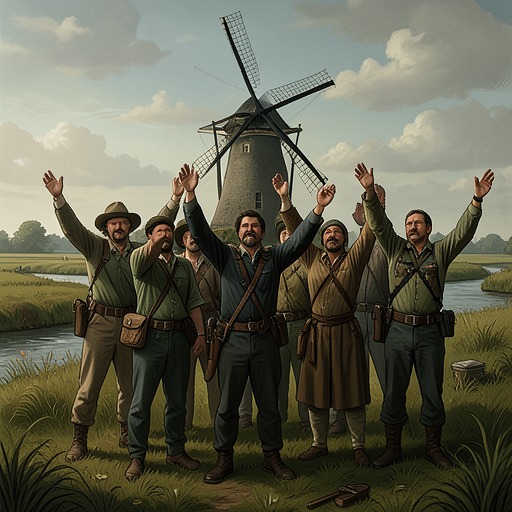
The approach to Haarlem displays the infrastructure that makes travel through the Dutch landscape possible. Along the canal, straight rows of bare willow trees run beside the ice, while a carriage road crosses the top of the great dike built to contain Haarlem Lake. The frozen water carries not only skaters but brown-winged iceboats, push-chairs, and small sleds propelled with iron-pronged sticks. The scene presents the canal as a route for many kinds of movement, while the dike beside it marks the constant work required to keep water within bounds.
At Halfweg, where the IJ and Haarlem Lake meet, Lambert van Mounen explains that the river lies five feet above the surrounding land. Strong dikes and sluice gates are therefore essential to prevent flooding. The sluices are shown as practical works of engineering, not distant technical curiosities: they regulate water at a vulnerable meeting point. Lambert also notes that spring water from the lake is used by Haarlem’s bleaching works, linking the same local water system to industry as well as safety.
The book places this local explanation within a national account of water management. Windmills pump water from lowlands into canals and help guard against inland floods; dikes require continuing repair, and neglect can leave towns and villages exposed to inundation. Haarlem’s landscape consequently carries two meanings at once: it is a picturesque skating ground and part of a network of barriers, canals, mills, and sluices on which habitable land depends.
The Organ and the City’s Public Memory
Peter takes the boys to St. Bavon’s Church, which is open that day so they can hear the Haarlem organ. Ben recognizes the instrument from his reading and anticipates its great pipes and human-voice stop. The stop is presented as a celebrated attraction in its own right, giving the traveling party a chance to compare what it has read with what the town offers in person. In the book’s broader design, such visits turn travel into a form of learning grounded in places and objects.
After leaving the church, the boys stop at a nearby marketplace to see the bronze statue of Laurens Janszoon Coster, whom many Dutch people regard as the inventor of printing. The narrative also records the dispute over that honor: others credit Johannes Gutenberg, while a further account holds that Faustus, Coster’s servant, took his master’s wooden types to Mayence. Haarlem’s attachment to Coster is tied to local pride in an illustrious townsman. The city’s first printed book, according to the account, is preserved in a silver case wrapped in silk and displayed cautiously as a precious relic. The statue and the carefully guarded book make the marketplace a site where civic identity is expressed through the preservation and celebration of history.
Haarlem in History and Story
Haarlem also supplies the setting and practical vocabulary for the embedded school lesson titled The Hero of Haarlem. The lesson describes a sluicer responsible for opening and closing the large wooden gates that regulate water entering canals. Because much of the Netherlands lies below sea level, it stresses that dikes and sluices must withstand rising water and that even a moment’s neglect can bring ruin. The town’s name thus connects a local historical tale to the wider realities of Dutch water control.
The book’s treatment of Haarlem reflects its stated aim of combining travel writing with a domestic story. Descriptions of the canal route, the church, and the marketplace give the journey the texture of a guided visit; the explanations of waterworks and civic memory make those sights instructive. Haarlem’s significance lies in this layering: the boys encounter a lively town on their skating expedition, while readers are shown how its landmarks and surrounding landscape preserve both practical knowledge and collective pride.